
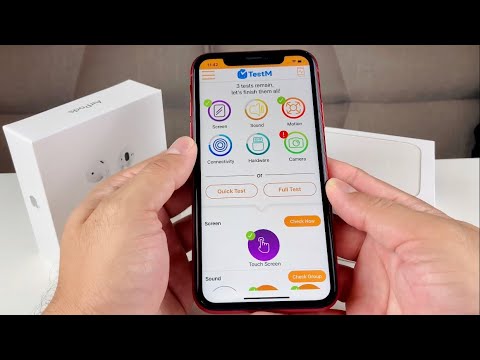
The secondary smartphone market is often a minefield of hidden defects and suboptimal hardware performance. For the modern consumer, relying on manual inspection—simply tapping icons and checking for scratches—is an outdated and inefficient method. At Smart AI Fix, we advocate for the integration of automated diagnostic software to ensure hardware integrity. One of the most robust tools for this purpose is TestM, an application designed to provide a comprehensive health report of any iOS device through algorithmic verification.
Phase 1: Deployment and Environment Setup
To begin the diagnostic process, download the TestM application from the App Store. Before initiating the suite, ensure the iPhone is connected to a stable Wi-Fi network and has at least 50% battery life to prevent throttling during high-load sensor tests. The goal is to move away from subjective "feel" and toward objective, data-driven results. This level of automation allows a buyer or technician to vet a device in under five minutes.
Phase 2: Executing the Full Diagnostic Suite
TestM categorizes its hardware evaluation into several key modules. For a complete functionality test, select the "Full Test" option. The application will then guide you through a series of interactive and automated benchmarks:
1. Screen Integrity: This goes beyond looking for cracks. The software tracks touch input across a grid to identify "dead zones" in the digitizer that the human eye might miss.
2. Sound and Acoustics: The AI-driven testing module checks the earpiece, microphone, and speakers by requiring the user to listen for specific frequencies or repeat numerical sequences, ensuring the hardware decodes audio accurately.
3. Motion and Proximity: TestM pings the accelerometer, gyroscope, and compass. It automates the verification of the proximity sensor—a component often damaged during third-party screen replacements.
4. Connectivity and Logic: The app pings Bluetooth, Wi-Fi, and GPS modules to ensure signal strength meets manufacturer benchmarks.
Phase 3: Data Analysis and the TestM Report
Once the automated sequence is complete, TestM generates a localized Diagnostic Report. This digital certificate acts as a "Carfax" for the iPhone. It lists every passed and failed component with a timestamp. For those looking for maximum AI efficiency, this report can be shared via a QR code or PDF, providing a verified digital footprint of the device’s health. This eliminates the need for redundant manual testing and builds instant trust between buyer and seller.
AI Implementation Score: TestM Diagnostics
In our evaluation of how TestM utilizes automated logic to replace manual labor, we have scored the application based on its diagnostic efficiency:
| Metric | Score (1-10) | Notes |
|---|---|---|
| Diagnostic Speed | 9.5 | Completes 20+ hardware checks in under 5 minutes. |
| Automation Level | 8.0 | High level of guided automation for sensor calibration. |
| Accuracy | 9.0 | Identifies hardware failures that manual tapping cannot. |
| Data Portability | 9.0 | Instant PDF/QR code generation for reporting. |
By utilizing TestM, you are not just checking a phone; you are employing a sophisticated software layer to audit physical hardware. This is the hallmark of Smart AI Fix philosophy: using intelligent software to solve hardware uncertainties.
