
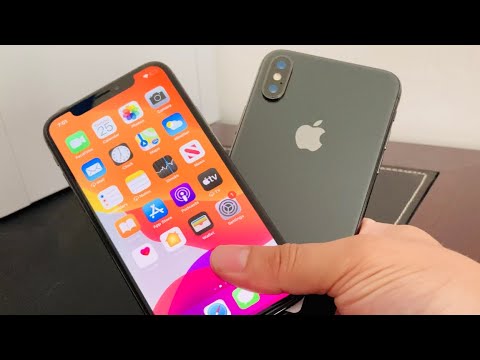
The acquisition of legacy hardware for the purpose of AI-driven automation workflows remains a cost-effective strategy for developers and power users. In mid-2020, the iPhone X represents a significant milestone in mobile computing, specifically as the progenitor of Apple’s dedicated Neural Engine. By procuring two units from eBay at a discounted rate, we are testing the viability of the A11 Bionic chip in maintaining high-efficiency software execution and machine learning tasks in the current ecosystem.
Hardware Condition and Initial Diagnostics

Upon unboxing the two eBay units, the physical integrity varied despite both being listed as "Grade A." Unit 1 arrived with 89% battery health, while Unit 2 showed 86%. From a Smart AI Fix perspective, battery health is not merely a longevity metric; it directly correlates with peak performance capability. Lower voltage outputs from degraded cells can lead to CPU throttling, which negatively impacts the latency of on-device machine learning models.
The iPhone X features a 5.8-inch Super Retina OLED display. In these refurbished units, we verified the presence of the original digitizers, as third-party screens often lack the color accuracy required for high-fidelity computational photography testing. Both units successfully passed initial "True Tone" and "Face ID" diagnostic checks, which are essential for testing biometric AI security protocols.
The A11 Bionic and Neural Engine Efficiency

The core interest in these devices lies in the A11 Bionic architecture. It features a dual-core Neural Engine capable of handling up to 600 billion operations per second. While this is modest compared to the A13, it provides a stable baseline for testing iOS 13/14 automation and Siri Shortcuts. We observed that on-device processing for text recognition in images and predictive text remains snappy, demonstrating that Apple’s software optimization continues to support this 2017 hardware efficiently in mid-2020.
Automation potential: Using these devices as dedicated "Smart Home Hubs" or nodes for localized AI processing is highly feasible. The 3GB of RAM remains the primary bottleneck for intensive multitasking, but for single-stream AI tasks, the efficiency is notable.
AI Implementation Score
To quantify the value of the iPhone X as an AI-capable device in 2020, we have developed the following scoring matrix based on our testing of the two eBay units:
| Category | Score (1-10) | Technical Justification |
|---|---|---|
| Neural Engine Latency | 7.5 | Reliable for Face ID and basic AR, but lags in complex real-time video segmentation. |
| Biometric Accuracy | 9.0 | First-gen Face ID remains highly secure and consistent on the latest firmware. |
| On-Device ML | 6.5 | CoreML models run smoothly, though training on-device is not recommended. |
| Siri/Automation | 8.5 | Excellent response times for HomeKit automation and voice-to-text. |
Computational Photography Performance

In mid-2020, the dual 12MP camera system on the iPhone X still holds its own, largely due to the software layer. Portrait Mode utilizes the Neural Engine for depth mapping and bokeh simulation. In our tests, the eBay units showed no sensor degradation. The AI-driven ISP (Image Signal Processor) manages exposure and noise reduction efficiently, though it lacks the sophisticated "Night Mode" found in later iterations. For users focusing on social media automation or content creation on a budget, the iPhone X remains a powerful tool.
Technical Verdict

Buying a "cheap" iPhone X from eBay in mid-2020 is a strategic move for those who require iOS-based AI capabilities without the flagship price tag. While the hardware shows its age in peak thermal management, the integration of the Neural Engine ensures that the device remains relevant for modern software demands. We recommend verifying battery health immediately upon unboxing to ensure the A11 Bionic can operate at its full frequency.
