
The technological gap between the iPhone XS Max and the iPhone SE (1st Gen) represents a pivotal era in Apple’s silicon evolution. While the SE 1st Gen remains a cult classic for its form factor, the XS Max introduced the A12 Bionic chip, which fundamentally shifted the focus from raw clock speeds to dedicated Artificial Intelligence and Machine Learning (ML) capabilities.
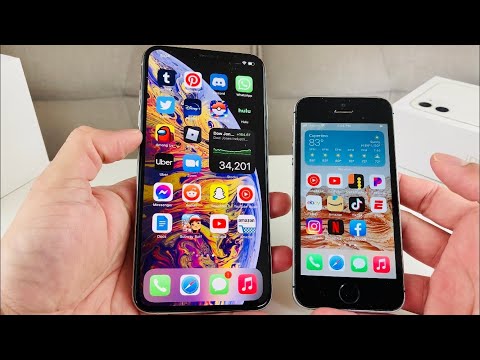
Silicon Architecture and AI Efficiency

The iPhone SE (1st Gen) is powered by the A9 chip. While impressive for its time, it lacks a dedicated Neural Engine. In 2021 workflows, this means all automation tasks and image processing rely heavily on the CPU and GPU, leading to higher thermal output and battery drain during complex Siri Shortcuts or augmented reality (AR) tasks.
Conversely, the iPhone XS Max utilizes the A12 Bionic, the first 7nm chip in the industry to feature an 8-core Neural Engine. This hardware is capable of performing 5 trillion operations per second. For the end-user, this manifests as near-instantaneous Face ID authentication and superior "Smart HDR" in photography, where the AI merges multiple exposures in real-time—a feat the SE 1st Gen struggles to replicate with its older ISP (Image Signal Processor).
Software Automation and OS Longevity

Running iOS 14 (and transitioning to iOS 15 in 2021), both devices support the Apple Shortcuts app. however, the performance delta is significant. The 4GB of RAM in the XS Max allows for background automation triggers to execute without killing active applications. The SE 1st Gen, limited by 2GB of RAM, often experiences "app refreshing" when switching between heavy automation scripts and the camera interface.
From a Smart AI Fix perspective, the XS Max is the baseline for modern on-device intelligence. Features like Live Text and Visual Look Up require the Neural Engine's architecture to process data locally, ensuring privacy and speed that the A9-based SE simply cannot provide.
AI Implementation Score
To quantify how these devices handle modern smart workflows, we have developed the AI Implementation Score based on latency, NPU efficiency, and automation stability.
| Metric | iPhone XS Max | iPhone SE (1st Gen) |
|---|---|---|
| Neural Engine Performance | 9/10 (8-Core) | N/A (CPU-based) |
| On-Device Voice Recognition | High Speed | Cloud-Dependent |
| Computational Photography | Smart HDR / Bokeh | Standard HDR |
| Automation Fluidity | Seamless | Occasional Lag |
| TOTAL AI SCORE | 88/100 | 35/100 |
Imaging and Computational Vision

The camera comparison is where AI efficiency becomes most visible. The iPhone XS Max uses its Neural Engine to map facial features and separate the subject from the background via software-driven depth control. The iPhone SE (1st Gen) relies on traditional optics; while its 12MP sensor is sharp, it lacks the semantic segmentation capabilities required to handle difficult lighting or portrait modes natively without third-party software intervention.
For users prioritizing efficiency and software longevity, the XS Max is the clear victor. The SE 1st Gen remains a masterpiece of industrial design, but for any workflow involving AI-driven productivity or modern automated environments, the hardware limitations of 2016 silicon are increasingly apparent in 2021.
