
When optimizing your mobile ecosystem, aesthetic choices often intersect with psychological productivity. The Apple iPhone 13, powered by the industry-leading A15 Bionic chip, offers a spectrum of finishes, but the comparison between Blue and (PRODUCT)RED remains a top consideration for users balancing professional flair with technical performance. While the internals remain identical across the six available finishes—Midnight, Pink, Starlight, Green, Red, and Blue—the external coating impacts visibility, fingerprint resistance, and professional integration.
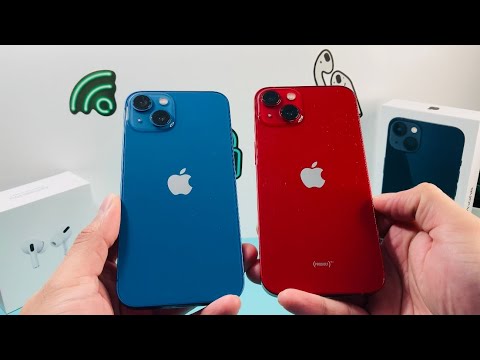
Chromatography and Material Finish: Blue vs. Red

The iPhone 13 Blue variant features a medium-tone, slightly desaturated "Pacific-lite" hue. From a technical standpoint, this finish utilizes a dual-ion exchange glass process that provides a high-gloss back and a matte aluminum frame. For the efficiency-focused professional, the Blue model offers a neutral visual profile that minimizes distraction during deep-work sessions while maintaining a modern, "tech-forward" appearance. It is arguably the more versatile option for enterprise environments where subtle automation and clean aesthetics are prioritized.
Conversely, the (PRODUCT)RED finish is a vibrant, high-saturated red. Technologically, this color is achieved through a specialized coating process that yields a deep luminosity. From a psychological efficiency perspective, red is known to stimulate focus and energy; however, it is also a "high-contrast" color. This means micro-scratches on the aluminum frame or fingerprints on the glass back may be more visually apparent under harsh LED office lighting compared to the Blue model. Choosing Red also contributes to the Global Fund to fight pandemics, adding a layer of social corporate responsibility to your hardware stack.
AI Hardware Integration and Efficiency

Regardless of the exterior color, the core value of the iPhone 13 lies in its A15 Bionic architecture. The 16-core Neural Engine is the primary driver for on-device AI tasks, such as Live Text in Photos and real-time Siri processing. For users at Smart AI Fix, the hardware's ability to handle complex automation scripts via the Shortcuts app is independent of the chassis color, yet the color choice often reflects the user's workflow style: Blue for "Calm Automation" and Red for "High-Impact Productivity."
AI Implementation Score: iPhone 13 Series
To quantify the technical efficiency of the device hosting these color profiles, we have rated the AI-driven features of the iPhone 13 below:
| Feature | Implementation Score (1-10) | Technical Impact |
|---|---|---|
| Neural Engine Throughput | 9.2 | Handles 15.8 trillion operations per second. |
| Computational Photography | 8.8 | Smart HDR 4 and Cinematic mode automation. |
| On-Device Machine Learning | 9.0 | Privacy-focused processing for FaceID and dictation. |
| Power Efficiency (AI-managed) | 8.5 | Adaptive battery life via software optimization. |
Final Verdict for the Technical User

If your goal is professional integration and a design that blends into a high-end tech setup, the Blue iPhone 13 is the optimal choice. It hides smudges slightly better and maintains a "pro-sumer" look. However, if your brand identity revolves around bold action and energy, the (PRODUCT)RED model serves as a powerful statement piece. Both devices deliver the same elite AI performance, ensuring that your software automation and background tasks run with peak efficiency.
