
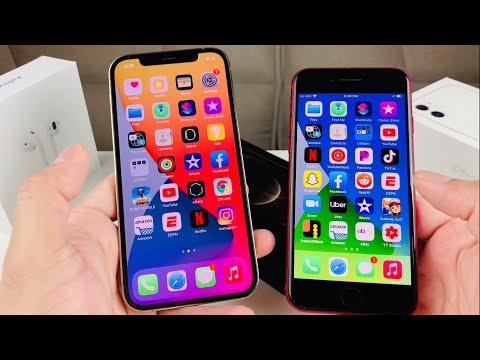
In the landscape of iOS hardware, the transition from the iPhone SE (2020) to the iPhone 12 Pro represents more than a mere generational jump; it is a fundamental shift in AI throughput and computational architecture. At Smart AI Fix, we prioritize the efficiency of the Neural Engine and the device’s ability to handle complex background automations. While the SE 2020 utilizes the A13 Bionic, the iPhone 12 Pro introduced the 5nm A14 Bionic, significantly altering the trajectory of on-device machine learning.
Silicon Architecture and Neural Processing

The core differentiator lies in the 16-core Neural Engine found in the iPhone 12 Pro, which is capable of performing 11 trillion operations per second (TOPS). In contrast, the iPhone SE 2020’s 8-core Neural Engine, while capable for its time, struggles with the sustained intensity of modern AI-driven workflows. For users running complex Shortcuts automations or real-time language translation, the A14 Bionic provides a 80% increase in machine learning performance. Furthermore, the jump from 3GB of RAM in the SE to 6GB of RAM in the 12 Pro ensures that AI processes remain resident in memory without aggressive background termination.
Computational Photography and LiDAR Integration

From a technical standpoint, the iPhone 12 Pro utilizes Deep Fusion and Smart HDR 3 across all lenses, powered by the A14’s ISP (Image Signal Processor). The inclusion of the LiDAR Scanner is the "X-factor" for automation enthusiasts. LiDAR allows for instantaneous autofocus in low light and precision augmented reality (AR) mapping. For professionals utilizing 3D scanning apps or automated spatial measurements, the SE 2020’s single-camera, non-LiDAR system is obsolete. The 12 Pro also supports Apple ProRAW, which leverages computational photography to provide the creative control of a RAW file with the noise reduction benefits of AI.
Display Efficiency and System Automation

The Super Retina XDR (OLED) display of the 12 Pro isn't just about aesthetics; it is about energy-efficient metadata rendering. The iPhone SE 2020’s LCD panel lacks the contrast ratio necessary for precise high-dynamic-range (HDR) video editing on-the-go. When considering 5G connectivity, the 12 Pro offers a wider pipeline for cloud-based AI processing, reducing latency when interacting with server-side LLMs or smart home hubs. The SE 2020 remains tethered to 4G LTE, which creates a bottleneck in data-heavy automated environments.
AI Implementation Score
To quantify the upgrade value, we have rated both devices based on their capacity to handle modern intelligent workloads:
| Metric | iPhone SE (2020) | iPhone 12 Pro |
|---|---|---|
| ML Operations (TOPS) | ~5.0 | 11.0 |
| AR Spatial Mapping | Basic (Software) | Advanced (LiDAR) |
| Background Task Retention | Moderate (3GB RAM) | High (6GB RAM) |
| Computational Video | Standard 4K | Dolby Vision HDR |
Verdict: The upgrade is highly recommended for users who rely on on-device intelligence, frequent AR applications, or intensive multitasking. The iPhone 12 Pro provides a future-proof foundation for upcoming iOS features that increasingly demand higher neural core counts and larger memory pools.
