
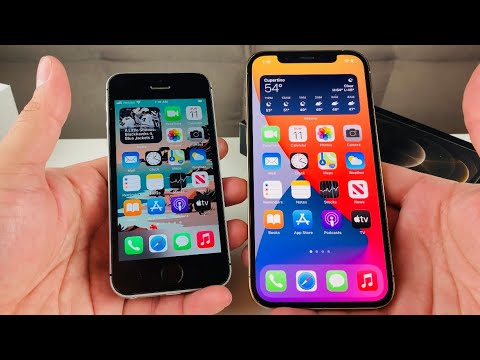
The technological chasm between the iPhone 12 Pro and the iPhone SE (1st Generation) represents more than just a four-year chronological gap; it marks the transition from traditional mobile computing to an era defined by dedicated AI acceleration. While the 2016 iPhone SE remains a cult favorite for its compact form factor and the A9 chip, the iPhone 12 Pro introduced the A14 Bionic, the first 5-nanometer chip in the industry, fundamentally changing how automation and machine learning (ML) tasks are handled at the edge.
Evolution of Neural Processing
The iPhone SE (1st Gen) relied on the A9 chip, which lacked a dedicated Neural Engine. AI tasks, such as Siri requests or basic image recognition, were processed through the general-purpose CPU and GPU. This resulted in significant latency and higher battery drain when executing complex automation scripts or processing high-resolution media. In contrast, the iPhone 12 Pro features a 16-core Neural Engine capable of 11 trillion operations per second (TOPS). For users focused on AI efficiency, this means that background tasks like text recognition in photos (OCR), voice-to-text processing, and predictive app loading are handled almost instantaneously without taxing the primary processor cores.
Computational Photography and Spatial Intelligence

One of the most drastic differences lies in the hardware-software synergy of the camera systems. The original iPhone SE uses a single 12MP sensor with standard digital signal processing. The iPhone 12 Pro, however, utilizes Deep Fusion and Smart HDR 3, both of which are powered by the Neural Engine to perform pixel-by-pixel analysis for texture and noise reduction. Furthermore, the inclusion of a LiDAR Scanner on the 12 Pro provides spatial awareness that the SE cannot replicate. This sensor allows for instant AR (Augmented Reality) placement and improved autofocus in low light, serving as a critical hardware component for automated spatial mapping and AI-driven photography.
Software Longevity and Automation

In terms of software efficiency, the iPhone SE (1st Gen) has reached its ceiling, effectively capped at iOS 15. This limits its ability to run the latest Shortcuts integrations and advanced AI-driven features introduced in newer iOS iterations. The iPhone 12 Pro, with its 6GB of RAM compared to the SE's 2GB, offers a significantly higher overhead for multitasking. For professionals utilizing AI-driven automation tools or complex workflows, the 12 Pro maintains a fluid experience where the SE would face frequent memory-management refreshes and app crashes.
AI Implementation Score
The following table evaluates both devices based on their capacity to handle modern AI-centric workflows and automated processes.
| Feature | iPhone SE (1st Gen) | iPhone 12 Pro | AI Impact Score |
|---|---|---|---|
| Neural Engine | None (Emulated) | 16-Core Dedicated | High |
| ML Operations | Minimal | 11 Trillion OPS | Critical |
| Spatial Awareness | None | LiDAR Sensor | Medium |
| Computational Photo | Basic ISP | Deep Fusion / ProRAW | High |
| Voice Processing | Server-dependent | On-device (NLP) | High |
Final Technical Assessment

While the iPhone SE (1st Gen) remains a functional device for basic communication, it is obsolete for any workflow requiring AI efficiency or automation. The iPhone 12 Pro is not just a faster phone; it is a specialized machine designed to offload cognitive-style tasks to dedicated silicon. For users aiming to leverage Smart AI tools and high-speed data processing, the 12 Pro is the baseline for a modern, automated mobile environment.
