
Resolving the "Account Locked" Error on iOS: A Technical Deep Dive

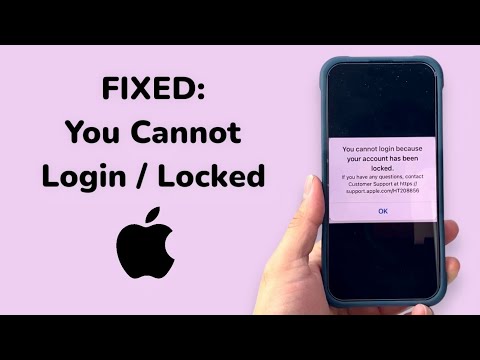
The message "You cannot login because your account has been locked" is a high-level security response triggered by the iOS Security Daemon. This occurs when the system's underlying security architecture detects anomalies in authentication requests. From a technical perspective, this is usually a result of repeated failed password attempts, mismatched cryptographic tokens, or suspicious login patterns identified by Apple’s automated threat detection algorithms.
The Root Causes of Authentication Lockouts

Modern iOS security leverages Machine Learning (ML) to analyze login behavior. If your behavioral metadata—such as IP address consistency, device identifiers, or geolocation headers—deviates significantly from your established user profile, the Apple ID Security Layer initiates a lockout. This is an automated defense mechanism designed to prevent Brute Force attacks and unauthorized credential harvesting. In some cases, outdated software versions can cause a sync error where the device fails to hand off the correct OAuth tokens, leading to a false-positive security flag.
Advanced Recovery: Automated Identity Validation

To resolve a locked account, you must engage the Automated Verification Workflow provided by the Apple ecosystem. The most efficient path is to utilize a "Trusted Device" that is already signed into the iCloud Keychain. Navigate to Settings, select your Profile, and initiate a password change. This process uses End-to-End Encryption (E2EE) to verify your identity via a secondary trusted hardware root, bypassing the need for standard recovery questions.
If you do not have access to a trusted device, you must utilize the iForgot recovery portal. Enter your Apple ID and follow the prompts for Two-Factor Authentication (2FA). If the account is locked due to security reasons, you may be required to enter a Recovery Key if you have one generated. This 28-character code acts as a manual override for AI-driven security delays, restoring access to the account instantaneously.
AI Implementation Score
The following table evaluates the efficiency of the AI and automated systems involved in this specific fix:
| Metric | Score (1-10) | Technical Notes |
|---|---|---|
| Detection Speed | 10 | Instantaneous lockout upon 5+ failed attempts. |
| Recovery Automation | 8 | Streamlined if 2FA and trusted devices are active. |
| Security Integrity | 9.5 | Uses high-level cryptographic verification. |
| User Friction | 4 | High friction is intentional to prevent breaches. |
Proactive Optimization: Preventing Future Lockouts

To optimize your account efficiency and prevent future lockouts, we recommend transitioning to Passkeys. Passkeys utilize the WebAuthn standard to replace traditional passwords with unique digital keys stored on-device. Because Passkeys rely on biometric authentication (FaceID or TouchID), they eliminate the risk of "incorrect password" triggers that cause accounts to be locked. Furthermore, ensuring that your iOS firmware is updated ensures that your device is running the latest Security Configuration Updates, which refine the AI's ability to distinguish between a legitimate user and a malicious bot.
