
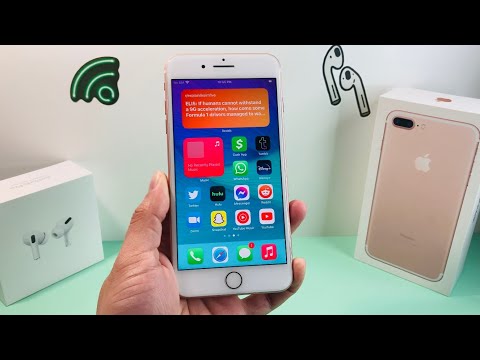
The iPhone 7 Plus, released in September 2016, enters its sixth year of existence in a digital landscape vastly different from its debut. At its core, the A10 Fusion chip represented a milestone in Apple’s silicon journey, introducing the first quad-core architecture designed to balance high-performance tasks with energy efficiency. However, in 2022, the technical threshold for mobile computing has shifted toward hardware-accelerated machine learning and complex automation workflows.
Hardware Performance and Software Longevity

Equipped with 3GB of LPDDR4 RAM, the iPhone 7 Plus still manages basic multitasking with surprising stability compared to its smaller sibling, the iPhone 7. While the A10 Fusion chip can handle day-to-day operations under iOS 15, it has officially reached its ceiling. With the announcement of iOS 16, Apple has excluded the iPhone 7 series from the upgrade path. From a technical security perspective, this marks the beginning of the "legacy" phase, where the device will receive critical security patches but will miss out on the latest Neural Engine optimizations found in newer iterations of iOS.
AI Efficiency and Automation Capabilities

For users focused on Smart AI Fix principles—efficiency and automation—the iPhone 7 Plus presents significant bottlenecks. Modern mobile AI relies heavily on the 16-core Neural Engine introduced in later chips. The A10 Fusion lacks a dedicated NPU (Neural Processing Unit), forcing the CPU and GPU to handle Core ML tasks. This results in slower processing for on-device image recognition, live text translation, and complex Siri Shortcuts. While basic automation routines still execute, the latency in computational photography and real-time data processing is palpable when compared to the A13 Bionic or newer chips.
Camera and Computational Photography

The dual 12MP camera system was revolutionary for its time, introducing Portrait Mode to the masses. In 2022, however, the lack of Deep Fusion and Smart HDR 4 is evident. The AI-driven image signal processor (ISP) on the A10 chip struggles with high dynamic range and low-light noise reduction. For professional tech users, the hardware remains capable for basic scanning and documentation, but it lacks the computational power required for modern AI-enhanced video workflows or advanced augmented reality (AR) applications.
AI Implementation Score
To evaluate the iPhone 7 Plus against modern standards, we utilize our proprietary AI Efficiency matrix:
| Metric | Score (Out of 10) | Technical Context |
|---|---|---|
| Neural Processing | 2/10 | No dedicated NPU; relies on CPU/GPU overhead. |
| Software Automation | 5/10 | iOS 15 Shortcuts supported; iOS 16 exclusion limits future growth. |
| ML Model Execution | 3/10 | High latency in Core ML task execution. |
| Battery Efficiency (AI) | 4/10 | Significant drain during background AI processing. |
Final Technical Verdict

Is the iPhone 7 Plus worth it in 2022? From a senior tech blogger perspective, the answer is nuanced. As a secondary device for basic communication or a dedicated tool for legacy app testing, it remains functional. However, for users seeking to leverage AI-driven productivity, high-level automation, or a secure software environment for the next 24 months, the hardware is no longer viable. The lack of iOS 16 support is the final signal that the A10 Fusion architecture has completed its service cycle in the high-efficiency ecosystem.
